Why are agricultural robots so visually appealing in demonstrations, but so difficult to commerciali
There is an interesting phenomenon in the agricultural robot industry:
The machines are becoming smarter and more sophisticated, and the demonstrations are getting more impressive. However, the products that can be sold on a large scale are still few.
At the exhibition:
The robot walks by itself.
The camera recognizes crops.
The AI identifies weeds.
It avoids obstacles automatically.
It turns around automatically.
It navigates automatically.
The robotic arm precisely grasps objects.
There was a burst of applause from the audience.
The 10-minute session at the exhibition: The robot walked by itself, automatically avoided obstacles, and the mechanical arm picked up objects. There was thunderous applause from the audience.
The investor said: The future is huge.
The client said: This technology is good.
The media said: Agricultural robots have arrived.
Then, the demo ended.
The real issues only began at this point:
Who will pay?
How many acres will be cultivated in a year?
How much is each acre worth?
How many times will it break down in a year?
Who is responsible for maintenance?
Can it work continuously during the busy farming season?
Will the client buy again next year?
Being able to run does not mean being able to do anything.he agricultural robot is most likely to succeed in the demo phase, but the hardest to succeed is in commercialization.
Being able to run does not mean being able to do anything.
The robot can run for 10 minutes in the exhibition hall, it's quite easy.
But agricultural production is not 10 minutes.
Real agricultural operations might be: 8 hours, 12 hours, several consecutive days, or even the entire farming season.
The demo proves that the machine can move.
Commercialization proves that the machine can complete tasks.
These two are completely different concepts.
An herbicide robot:
In the demo, it identifies weeds, the actuator moves, the weeds are dealt with, and the success rate seems very high.
But when actually going into the field: the soil is different, the light is different, the size of the crops is different, the density of the weeds is different, the ground is uneven, the tires slip, the lens is covered with dust, it suddenly rains, people appear in the field, the robot gets stuck, the actuator gets clogged, the battery runs out, communication is interrupted.
The real problem becomes:
Can it really finish 100 acres, 1,000 acres, or 10,000 acres of work?
This is what we call operational capability.
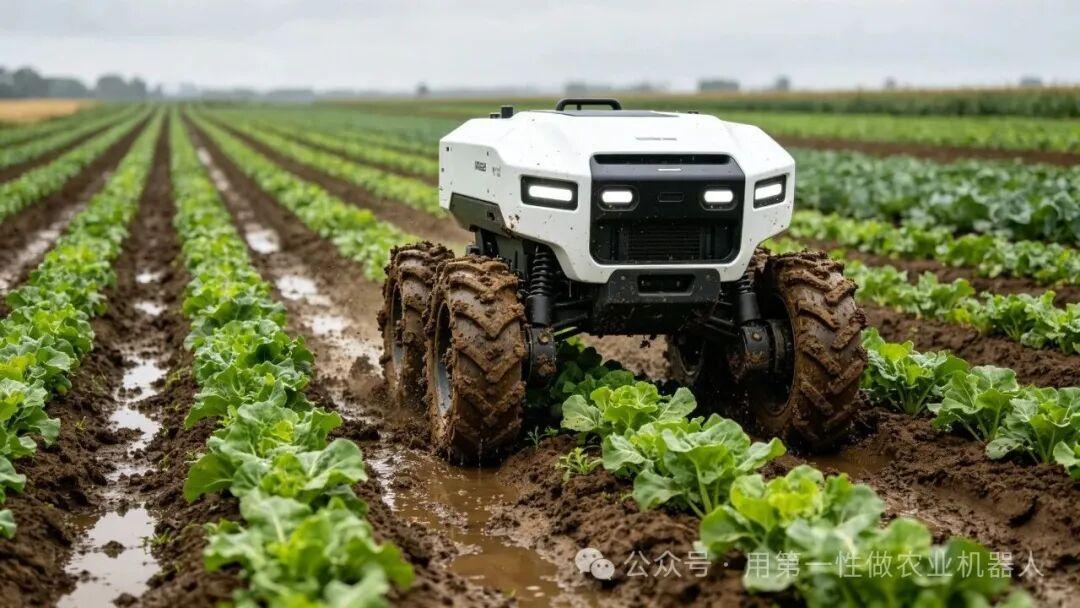
After the downpour: Mud, muddy water, dust, slippery tires. Only when 1,000 acres of land can be truly tilled can it be considered a success.
Being competent does not mean being able to do the job consistently.
The biggest enemy of agricultural robots is often not the algorithms, but rather: mud, water, dust, vibration, high temperature, low temperature, load and farming seasons.
In the laboratory, the recognition accuracy rate is 99%, but in the field, it may suddenly fail due to the lens getting dirty.
The path planning is perfect in the laboratory, but in the field, a pit, a patch of water, or a tire slip could interrupt the task.
So the indicators that really need to be focused on are not just the recognition accuracy rate, but also:
MTBF, MTTR, PP1000H, PP1000 mu, task success rate, manual takeover rate, effective operation rate.
In particular, the reliability of farming seasons should be closely monitored.
When a car breaks down, it's about repairing the car. But when a farm machine breaks down, it means missing the farming season.
Missing the farming season means losing the income for this season.
Being able to work steadily does not necessarily mean being able to make money.
This is where a large number of agricultural robot projects truly began to die.
Suppose a robot costs 200,000 yuan, has excellent technology and reliability, and can work for 1,000 hours a year. It sounds great.
But why would a customer spend 200,000 yuan on it?
The customer doesn't care about your BOM: what chips were used, how many TOPS, what vision model, how many lines of LiDAR, what controller.
The customer only cares about three things:
How much did I spend per acre before?
How much do you now ask me to spend per acre?
How much can I save per year?
Agricultural robots are not priced based on BOM, but based on productivity.
What robots really matter is not how much one costs, but how much they cost per acre.
This is the most crucial financial transformation for the commercialization of agricultural robots.
A robot costing 200,000 yuan, over a period of 5 years:
If it only works on 1,000 acres per year, the total operational area during its lifespan is only 5,000 acres. Just the depreciation of the equipment alone is 40 yuan per acre.
Not to mention electricity costs, fuel, maintenance, labor, transportation, insurance, software, after-sales service, and financing costs.
In the end, it is likely that: although the robot seems very advanced, the cost per acre is simply not competitive with the traditional methods.
The same robot, completing 5,000 acres per year over 5 years, a total of 25,000 acres:
The sole equipment cost is only 8 yuan per acre.
At this point, the commercial logic is completely different.
One of the most important commercial indicators for agricultural robots is not sales volume, but utilization rate.
A real case: Why would a farm still purchase a robot worth 1.2 million dollars?
Many domestic agricultural robot entrepreneurs, upon seeing the $1.2 million price tag, immediately thought:
So expensive! How could farmers afford it?
But what should really be considered is not how much the robot costs, but how much value it can generate for customers each year.
Let's look at the robot's own financials first.
The Braga Fresh farm in California, USA, once conducted a commercial application assessment of Carbon Robotics' LaserWeeder.
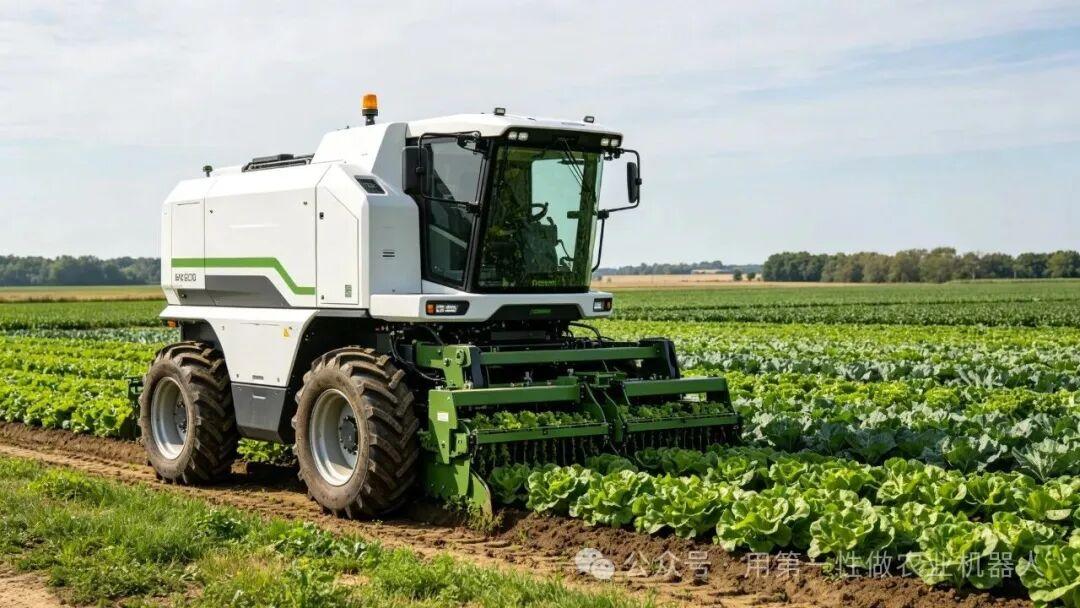
Case protagonist: Carbon Robotics LaserWeeder, with a purchase price of approximately $1.2 million.
Assuming a 5-year depreciation period and covering 2,350 acres per year, the equipment depreciation alone amounts to approximately $102.13 per acre.
In addition to the tractor, fuel, two operators, hardware and OTA services, transportation, and other operating costs, the total operating cost reaches $267.72 per acre.
This is not a cheap robot.
But here's the question: How much did the customer originally spend on manual weeding?
Let's take a look at the customer's original expenses.
Before using the LaserWeeder, Braga Fresh's manual weeding cost was approximately $900 per acre.
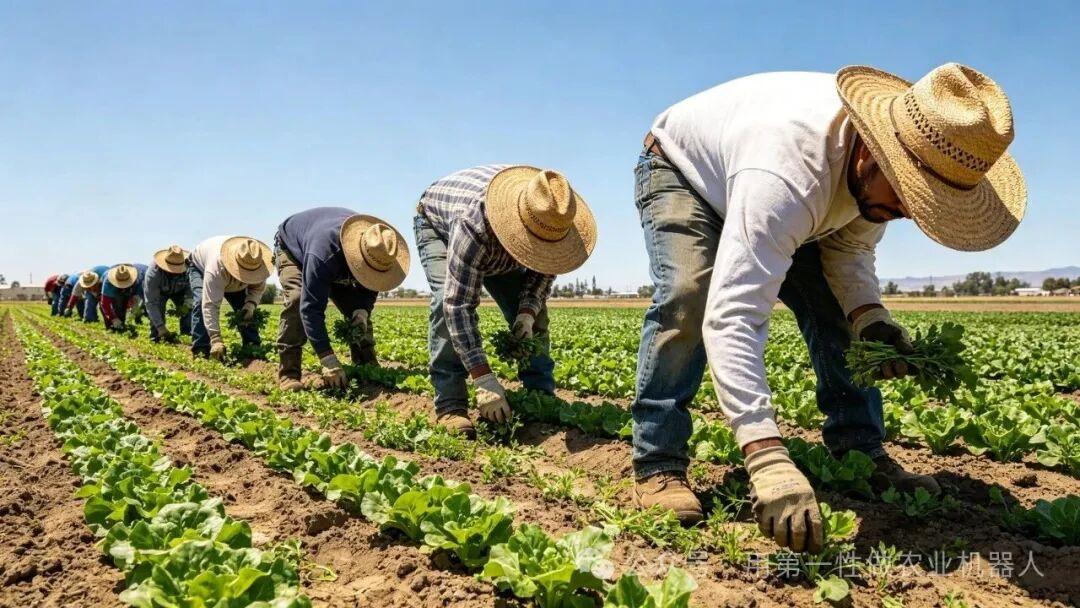
The original production method of the customer: manual bending over to remove weeds, with a cost of approximately $900 per acre.
After using the robot:
Robot operation: $267.72 per acre.
After using the robot, there is still the need for manual supplementary weeding: $282.28 per acre.
Total: $550 per acre.
So: Originally $900, now $550, saving $350 per acre.
One year covers 2,350 acres: 2,350 × 350 = $822,500 per year.
One robot worth $1.2 million can generate approximately $822,500 in direct weeding cost savings per year, and the annual weeding cost decreases by about 39%.
At this point, if you look back: Is $1.2 million expensive?
The answer is no longer whether it is expensive or not, but whether it can create sufficient productivity value in a year.
But the truly interesting part is yet to come.
The same robot does not always generate profits on every piece of land.
Western Growers' case study of another farm, Triangle Farms, found that the operating cost of LaserWeeder is approximately $448.73 per acre.
There are huge differences in economic performance among different crops: Some organic crops can achieve significant savings; however, in the case of direct-sown lettuce, the combined weeding cost of the robot is actually higher than manual weeding by $88.73 per acre.
Ultimately, Triangle Farms, after comprehensive calculation of multiple crops, still achieved savings of approximately $430,000 per year, with a overall cost reduction of about 40%.
Robots do not inherently make money. They can only generate income when they are placed in the right environment.
This precisely leads to the next topic we are going to discuss:
Why are many agricultural robots not due to technical flaws, but rather because the environment they are placed in is incorrect?
Therefore, agricultural robots actually need to consider four aspects:
The first equipment account: How much does the robot cost? $1.2 million, and this is just the beginning.
The second operation account: How many acres can it handle in a year? In this case, it's 2,350 acres per year. If it can only handle 300 acres in a year after being purchased, all the previous business models will collapse.
The third substitution account: How much did the original production method cost? $900 per acre. How much will the robot cost in the future? $550 per acre. The real commercial value is $350 per acre.
The fourth life cycle account: How many years can it work? How many acres can it handle per year? How much does it save per acre? What are the maintenance, personnel, relocation, and residual value costs? How many years will it take for the customer to recover the cost?
Equipment investment → Annual operation volume → Unit operation cost → Customer savings → Payback period → Life cycle value.
This is the true commercial model of agricultural robots.
It's even possible to work backward to determine the selling price.
Suppose the current customer's operation cost per acre is 100 yuan, and the robot must leave the customer an economic value of at least 30 yuan per acre. Then the robot's total cost per acre must be controlled within 70 yuan.
If it can handle 5,000 acres in a year, theoretically it can create 150,000 yuan of direct customer economic value.
The customer requires a 3-year payback period. The investment space that the robot can withstand is around 450,000 yuan.
At this point, you will know how much your product should be priced, rather than first calculating the BOM and then adding a 30% gross profit.
The true algorithm of agricultural robots is not BOM → Selling price → Finding customers; it's customer original cost → Robot operation cost → Customer savings → Annual operation volume → Payback period → Acceptable selling price → Target BOM. The order is completely reversed.
Agricultural robots do not first calculate the BOM and then find the selling price; instead, they first calculate how much productivity the customer is willing to pay for, and then work backward to determine what the robot should look like and what its cost should be.
This is why: Agricultural robots are first an economic issue, and then an engineering issue.
Technology is responsible for making the robot capable of working.
Engineering is responsible for making the robot work stably.
Business model is responsible for making the robot worthwhile to work.
And the final financial model determines whether this company can survive.
The truly expensive thing is not the robot itself, but the fact that it only works for a few hundred hours a year.
A car can travel over 10,000 kilometers in a year.
An engineering equipment can work at a high intensity continuously.
However, many agricultural robots may have very limited effective working time in a year.
The reasons include: seasonal variations, crop cycles, weather conditions, land dispersion, relocation, operation windows, tool switching, and fragmented customer base.
If a robot only creates value for 300 hours in a year,
what you bought is not a production equipment.
What you bought is an expensive idle asset.
The biggest business pitfall: mistaking customers' preferences for customers' purchases
This is the most dangerous illusion in the entire industry.
Just because a customer says it's good doesn't mean I'll buy one.
Just because a customer says it has great potential in the future doesn't mean I'll allocate a budget of 200,000 yuan this year.
Just because a customer is willing to try it for free doesn't mean I'm willing to continue paying.
Customers should be classified into different levels:
Viewed → Interested → Willing to try → Willing to pay for a trial → Sign a contract → Make a formal purchase → Repeat purchase.
Real commercialization, at the very least, needs to cross the threshold of willingness to pay.
And the real product validation is the customer's second purchase.
What is most easily demonstrated by the demo is precisely not the most important aspect of commercialization.
Why do industries like Demos? Because Demos are particularly good at telling stories.
Robots walking by themselves are visually appealing.
Mechanical arms grasping apples are visually appealing.
AI identifying weeds is visually appealing.
Automatic obstacle avoidance is visually appealing.
However, the truly important indicators for commercialization may not be visually appealing at all:
How many hours of effective operation per day?
How much is the cost per acre?
How much is the loss per failure?
How many minutes is the Mean Time To Repair (MTTR)?
What is the rate of manual intervention?
How many acres are actually operated in a year?
What is the customer retention rate?
What is the gross profit per unit of its lifecycle?
These data are not suitable for a press conference, but they determine whether a company can survive.
Demos are communication indicators. Payments are commercial indicators. Retention is a product indicator. Cash flow is the survival indicator of a company.
The five gates that agricultural robots should truly pass through
Compress the commercialization process into five stages:
Stage 1: Can Move - The robot can move autonomously.
Stage 2: Can Perform Tasks - It can actually complete agricultural tasks.
Stage 3: Can Perform Stably - It can operate continuously in a real agricultural environment.
Stage 4: Can Make Money - After customers use it, the economic benefits are established.
Stage 5: Can Generate Large-scale Revenue - It can replicate customers, replicate scenarios, replicate products, replicate services, replicate orders, and replicate cash flow.
All five stages are indispensable.
Running ≠ Being Capable; Being Capable ≠ Being Stable in Operations; Being Stable in Operations ≠ Making Money; Making Money ≠ Generating Large-scale Revenue.
These four "≠"s might be the four most important cognitive dividing lines in the commercialization of agricultural robots.
Why do many companies become increasingly complex, yet end up further away from commercialization?
Because entrepreneurs tend to get trapped in a technology-driven approach:
Today, add a LiDAR; tomorrow, add a camera; the day after, upgrade to a higher computing power.
Then add a robotic arm, increase the model size, add automatic charging, add multi-machine collaboration.
Finally: more and more functions, higher and higher BOM costs, more and more complex systems, more and more difficult maintenance, and customers can no longer afford them.
This leads to a very absurd result:
The robots become increasingly intelligent, but the business model becomes increasingly untenable.
The truly good agricultural robots follow the principle of minimum complexity:
For every additional function, one should ask: How much productivity does this function actually increase?
If adding 1,000 yuan in cost only brings 500 yuan in annual value, why add it?
If a sensor increases the system complexity by 20% but only improves 1% of the operational efficiency, why add it?
Not more technology is better, but at the lowest complexity level, complete the highest value agricultural tasks.
How should one start an agricultural robot startup?
The typical path for many startups is: find technology → build the foundation → develop AI → create a demo → participate in exhibitions → find customers.
The problem with this approach is that the product comes before the demand.
A more reasonable sequence should be reversed:
Identify pain points → Identify orders → Calculate acreage → Calculate ROI → Define tasks → Then define the robot.
Or even more boldly:
First secure 1000 real orders, then decide what the robot should look like.
Because what the customer actually buys is never the robot itself, but the completion of 1000 acres of work.
Who are the real competitors of agricultural robots?
Many entrepreneurs' first reaction is: another robot company.
But that's not necessarily the case.
The real competitor might be: human labor, traditional agricultural machinery, agricultural service teams, semi-automatic equipment, existing outsourcing services, or even: the customers continue to use the current methods without any change.
So, to determine if a robot is competitive, we shouldn't ask how much more advanced we are compared to another robot, but rather why the customers don't continue to use the current methods.
A robot only has a commercialization opportunity when it has a clear advantage in terms of lower cost, higher efficiency, more stable quality, longer operation window, easier management of human labor - at least one of these aspects.
The true commercial engine of agricultural robots is not technology.
A healthy flywheel should be:
Orders → Robot operations → Real data → Product optimization → Reliability improvement → Unit cost reduction → Increased customer ROI → More orders → Higher robot utilization → Further unit cost reduction → More orders.
This is a healthy business flywheel.
An unhealthy path is: Financing → Research and development → Demo → Financing → Re-research and development → Re-demo → Re-financing.
If the robot always stays on the second path, it is likely to eventually become: a technology company that keeps doing demos, rather than a real enterprise that creates agricultural productivity.
The three numbers that truly deserve the attention of agricultural robot entrepreneurs
If you can only look at three figures today, I suggest you look at the following:
First: Effective productivity rate - How much time does a robot actually spend creating production value each day?
Second: Unit production cost - How much does it cost per acre, per hour, per ton?
Third: Repeat purchase rate - Will the customer continue to buy from you next year?
Because these three figures respectively answer: Can it be done? Is it worth doing? Will the customer be willing to continue to let you do it?
Don't be fooled by the Demo.
The agricultural robotics industry is entering a very crucial stage.
Over the past few years, the industry has proven that robots can enter agriculture.
What really needs to be demonstrated next is that robots can become an agricultural productivity factor.
These two sentences seem to differ by just a few words, but in reality, they represent an entire commercial gap.
From demo to production, from production to profitability, from profitability to large-scale profitability.
This is the true long-distance race of agricultural robotics.
If you are working on agricultural robotics, please consider these new questions:
Stop asking if my robot can be made. Start asking why the customer wants to buy it today.
Stop asking what the recognition rate is. Start asking how much effective work can be created in a year.
Stop asking how many units I can sell. Start asking how many acres per year each robot can generate.
Stop asking if my technology is leading. Start asking if the customer will make money after replacing the previous production method.
Because what ultimately determines the survival of an agricultural robotics company is not how beautiful the demo is, but whether it can become a more affordable, more reliable, and more sustainable productivity.
The commercialization of agricultural robotics can be condensed into four sentences:
It can run, but it doesn't mean it can do it well.
It can do it well, but it doesn't mean it can do it stably.
It can do it stably, but it doesn't mean it can make money.
It can make money, and then it has the qualification to talk about large-scale production.
The true end point of commercialization is not to sell more robots, but to ensure that each robot can continuously generate productivity that can be paid for by the customer.
Robots are not the goal. Productivity is the goal.
Thought:
1. Starting an agricultural robot business is not the hard part - getting it to move is easy enough.
2. Why would a farm still purchase a $1.2 million herbicide robot?
3. Most agricultural robots die between the third and fourth gates - they can run, work, be stable, and make money, but they often fail.
4. Agricultural robots are not a technical issue; they are an economic one.
5. Don't be fooled by demos anymore: what agricultural robots should calculate is "how much per acre".
Content verification:
1. Case data source: Western Growers Center for Innovation & Technology official case study "Specialty Row Crop Farms Cut Weeding Costs by ~40% with Laser Weeding" (released in April 2024, wga.com). Core figures have been cross-checked against public sources: the machine's purchase price is approximately $1.2 million; calculated based on 5-year depreciation and 2,350 acres per year, the equipment depreciation is approximately $102.13 per acre; including two operators, hardware and OTA services, tractors, fuel, logistics, etc., the comprehensive operating cost is $267.72 per acre; after manual weed removal, the total cost is $550 per acre; saving $350 per acre; annual savings of $82,250, a 39% reduction.
2. Triangle Farms case: The cost of laser weeding in the organic romaine lettuce scenario exceeds simple manual weeding by $88.73 per acre; even after comprehensive calculation of multiple crops, a savings of approximately $430,000 per year and a 40% overall cost reduction is still achieved.
3. "200,000 yuan, 5 years, 1,000 acres → 40 yuan per acre; 5,000 acres → 8 yuan per acre" is an illustrative calculation model used to demonstrate the "how much per acre" calculation method, not specific company data.
4. "Reversing the selling price" section (original cost of 100 yuan, leaving 30 yuan, comprehensive cost of 70 yuan, 5,000 acres per year, $150,000 per year, 3-year payback, $450,000 investment space) is a method demonstration, with parameters being hypothetical values, used to illustrate the algorithm of "reversing the selling price based on customer value".
5. Image sources: The cover image and 4 real/production photos (exhibition demo, field operation, manual weeding, LaserWeeder product image) are all generated by AI; the economic account graph data of the case comes from the above official Western Growers case study; the five gates, customer conversion funnel, and business flywheel three information diagrams are original structural schematic diagrams, not official charts.
6. When reprinting and citing case data externally, please indicate the source "Western Growers official case study (2024)".
